Quality control is one of the important parts of the manufacturing process. In garment manufacturing specially the problems are mostly found at the end of the production. But this is not the right way to do it.
If you are finding defects at the end of the final inspection, you know that your factory has already spent a lot of time, labour, and resources reducing those defects. By then making changes there is going to be expensive and sometimes impossible.
This is the reason why many government manufacturers are using a system called TLS, which is the full form of traffic light system. The goal of this system is simple it is to find problems early on, even before they make it to the end of the production line.
Check out our digital swatch here
What Is TLS in the Garment Industry?
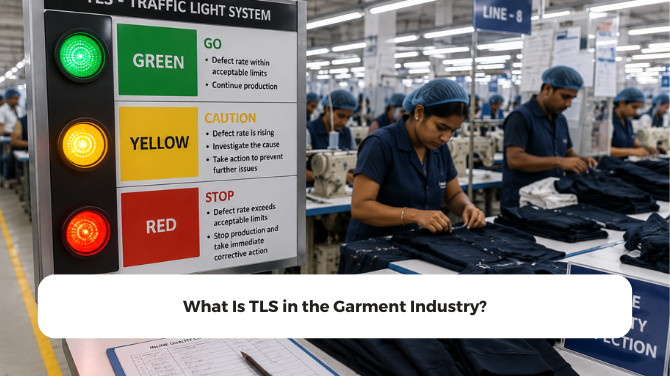
TLS, which stands for traffic light system, is an inline quality control method that is used in various government manufacturing units in order to monitor the quality of production while the swing is still in progress.
This is a simple system that uses three colours that are recognised by almost everyone. it contains green, yellow, and red.
If everything is in control, the light will turn green.
If any attention is required or a question arises, the light will turn yellow.
If any immediate action is required, then the light will be red.
So you can see that this is a straightforward idea that instead of waiting until the production is complete, the quality team can actually monitor defects continuously during the sewing process and react instantly without waiting for the sewing process to end.
Why Factories Use TLS
Many of the quality issues in a garment manufacturing unit start with something small. things like uneven stitching, a change in machine setting, or a measurement issue that appeared during production.
You may think that it is only happening to a few pieces at the beginning, but until it spreads throughout the manufacturing, no one is going to notice. This is why the TLS system is really useful.
The inspectors, who are the quality control specialists, can easily identify Trends using the light system even before they become major quality failures.
How The Traffic Light System Works
Each government manufacturing unit has its own threshold when it comes to how this system works, but in general, the system works as follows:
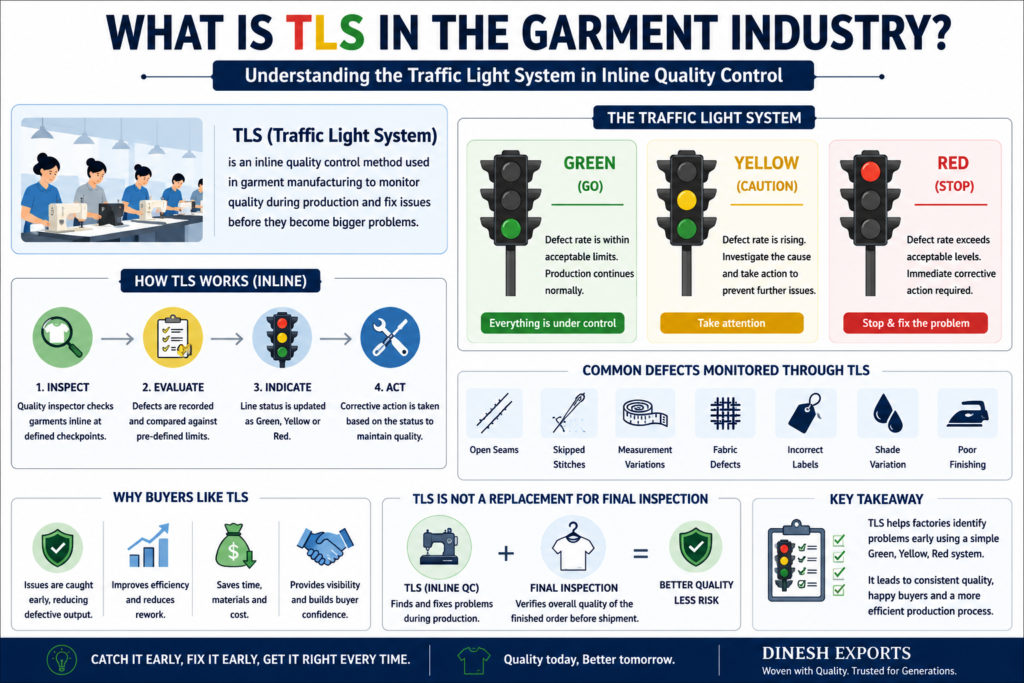
Green Status
If a unit is in green, it indicates that the defect rate is within the acceptable limits set by the factory. There are no actions to be taken here, so the production continues normally.
Yellow Status
When the inspectors see a yellow light, they immediately start investigating the cause of the defects at that unit. They will supervise and increase monitoring in order to provide additional guidance to the printers so that their yellow status turns green.
Here, the main objective is to prevent the unit from going into a red status.
Red Status
If a unit is in red colour, you can be sure that the defect rate at that unit has exceeded the acceptable levels of the factory. This unit will require immediate corrective actions from the team.
In some cases, the production may be stopped immediately until the route cost is identified and characterized. This is only a temporary stop after production. The reason why the production managers and quality inspectors do this is in order to prevent defects in large quantities of production.
TLS Is Mainly Used During Inline Inspection
So the TLS system is completely different from the final inspection in quality control. While DLS is normally a part of the inline quality control system, it is finding difference way before it reaches the final inspection stage.
The inspectors are evaluating garments while they are in production and are running. Based on the defect starts and findings, still update the traffic light status. So the defects actually get corrected even before it reaches the final inspection, but many people confuse TLS with the final inspection system.
In our recent article on how to reduce garment sample development time, we have discussed a similar quality control approach. Feel free to check it out
Common Defects Monitored Through TLS
The traffic light system is a simple quality control method that can be applied to almost any sewing defect. Look at the examples below that can be applied:
- Open seams
- Skipped stitches
- Measurement variations
- Fabric defects
- Incorrect labels
- Shade variation
- Poor finishing
The checkpoints are actually defined by either the buyer or the factory during the quality standard procedure.
Why Buyers Like TLS
Buyers, especially in the export market, are really conscious about the quality. They are not in favour of manufacturers that only check quality at the end of the production process.
If you implement the TLS system, it will easily create visibility into how each of the government is produced and how the quality is checked.
This will allow buyers to understand that you are serious about quality control and that the production team is productive in taking measures to correct those problems. Buyers will gain confidence in your quality control and in you.
TLS Is Not A Replacement For Final Inspection
Now you may think that you need to replace your final inspection with the TLS system. But that is not the right move. TLS will not eliminate the need for the final inspection; it is still important to have the final inspection to verify the overall quality of the completed order before shipping it to the client.
The TLS system is only a warning system that will keep you in check while the production process is going on. So both the final inspection and the TLS system are important and work together.
The Role Of Fabric Quality In TLS Performance
It is worthy to point out that the DLS system cannot identify quality issues in the fabric. We know that quality issues are not only generated in the sewing department, but also in the fabric manufacturing process.
Fabrics can also have defects due to inconsistent GSM, weaving faults, and other fabric manufacturing process defects. This is a reason why you need a reliable fabric Sourcing manufacturer like Dinesh Exports to minimise the risk of fabric defects in your garment production.
We have discussed related topics in our articles on fabric GSM and woven fabric suppliers in India.
Working With Quality-Focused Manufacturing Partners
At Dinesh Exports, we have been providing bovan fabrics of all types for more than three decades across plain weave, twill weave, jacquard fabric, Dobby fabric, yarn dyed fabrics, linen blend fabrics, and all types of sustainable fabrics.
We have more than 200 employees working towards achieving the goals for our clients, from product development to shipping. We also ensure that our clients get the right after-sales services.
If you’d like to learn more about us, feel free to contact us here.
Final Thoughts
The TLS quality control system is a simple and Powerful process you can put in place in order to avoid large-scale production quality control issues. By using recognisable colours like green, yellow, and red, Quality inspectors can easily identify issues and rectify them before it gets out of control. This will help manufacturing units to reduce rework and improve their efficiency while keeping their consistent quality in place. In garment manufacturing, it is always better to catch problems early on rather than fixing them later.
Frequently Asked Questions
What does TLS stand for in the garment industry?
The traffic light system is a quality control method used in the production of garments.
What are the three TLS colors?
Green, Yellow, and Red.
Why is TLS used in garment manufacturing?
It is better to identify quality issues early on in the production process rather than finding it at the end of the quality check.
Is TLS the same as final inspection?
DLS is not the final inspection; it happens at the end of the production process.